
American Backsliding?
What's driving the backward slide in democracy in the US?

[A quick note: I didn’t record a voiceover for this post. Apologies to anyone who likes those. Final grades are due, so I didn’t have a chance. I’m also getting over what I think is a cold, so my voice isn’t at 100% capacity at the moment anyway. At any rate, thank you to my subscribers for your support! Now, on with the show.]

Many moons ago I wrote a post about democratic backsliding in the United States. In that post I made the point that when measures of democracy move up or down, it reflects certain assumptions about what counts for democracy, and what doesn’t. When you see one of these measures change for the worse, or for the better, you should pause and try to under stand why.
In this post, I want to hit pause and better understand why one measure in particular—V-Dem’s polyarchy index—is so bearish on American democracy. The culprit won’t be much of a surprise: Congress.
How is any of this relevant to international relations?
First of all, democratic backsliding threatens US leadership of the Liberal International Order. I’m actively pursuing research on international order collapse, and I’ve written before that major breaks in ideological alignment between order leaders and their subordinates co-occurs with order collapse. A recent study suggests that alignment on governance matters for order health, too. This is something I’ve recently confirmed in my own research (which I may share here at a later date).
Second of all, the reason for democratic backsliding has an impact on international conflict. In some other research that I recently presented at the March 2026 gathering of the International Studies Association, I found that constraints on country leaders moderate the effect of a leader’s hawk bias (their predilection for using military force instead of peaceful negotiation) on the chance of international conflict initiation. Bust most importantly of all, I found that strong legislative oversight mostly drives this relationship. Democracy itself doesn’t.
Both of these points make the trends in the data worth paying attention to.
Backsliding by the numbers
The trend that gets most of the headlines is that American democracy is weakening. The below figure shows the trend in America’s democracy score based on V-Dem’s polyarchy index, and it’s easy enough to see a downward trajectory over the last decade. V-Dem’s index is a 0-1 scale, where a 1 is the best possible score a country can have, and a 0 is the worst. The figure below shows the score by year for the US from 1950 to 2025 alongside a smoothed over yearly average of all country democracy scores over the same period. The US is well above average, even now. Its quality of democracy, while eroding, isn’t as low as it was in 1950. Things aren’t as bad as they could be, but the negative trajectory is concerning.
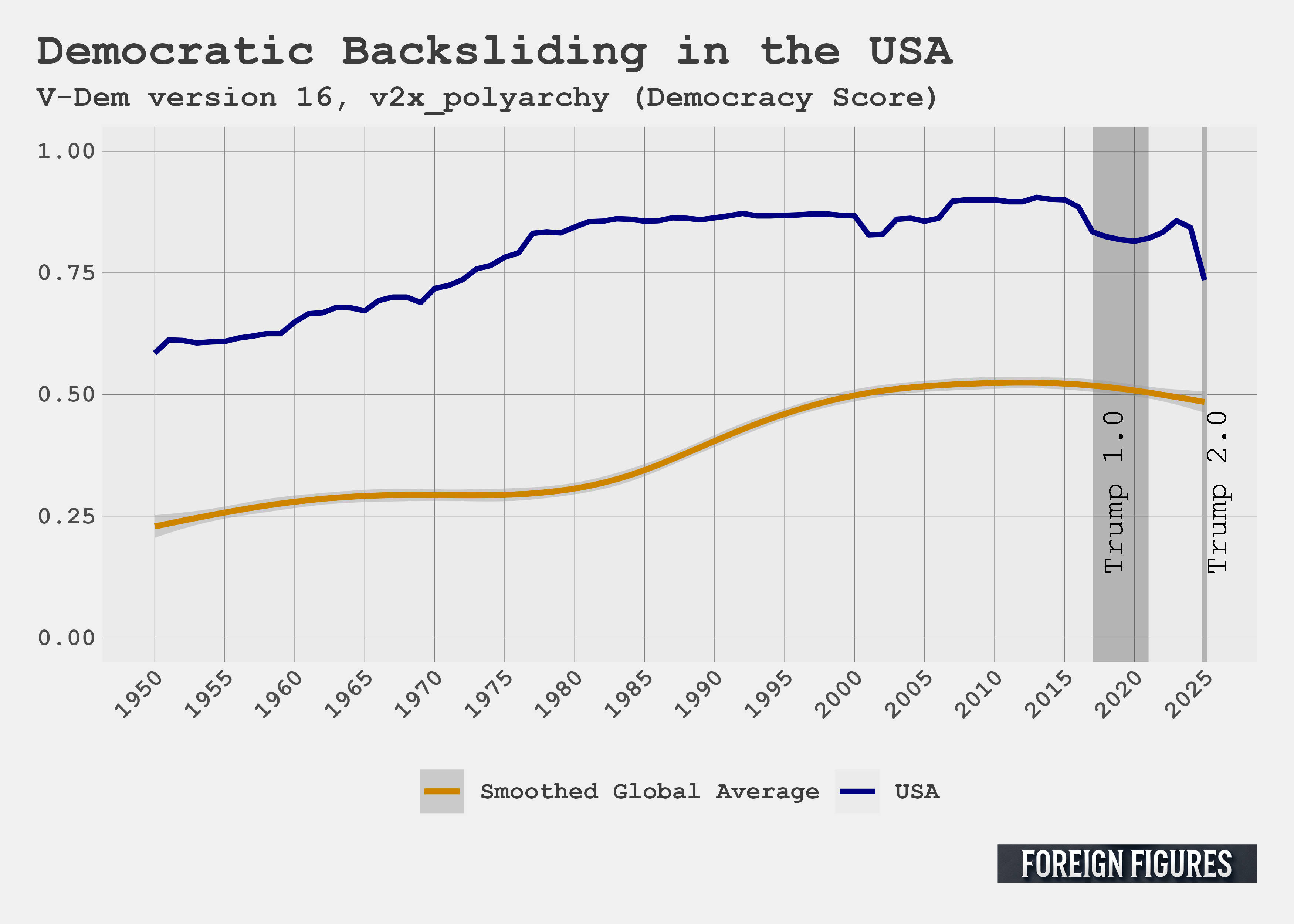
But what exactly is driving America’s democracy score downward? My guess is the reason for the downward trend over the last decade isn’t the same reason for America’s poor score in 1950 and the few decades that followed. You can blame the Jim Crow South for that.
To answer this question, you have know a little something about how V-Dem’s democracy measure is constructed. V-Dem relies on an extensive survey of country and area experts to construct a measure of democracy. That survey has many subcomponents that ask experts about all kinds of dimensions of democratic accountability. One of those deals with legislative constraints.
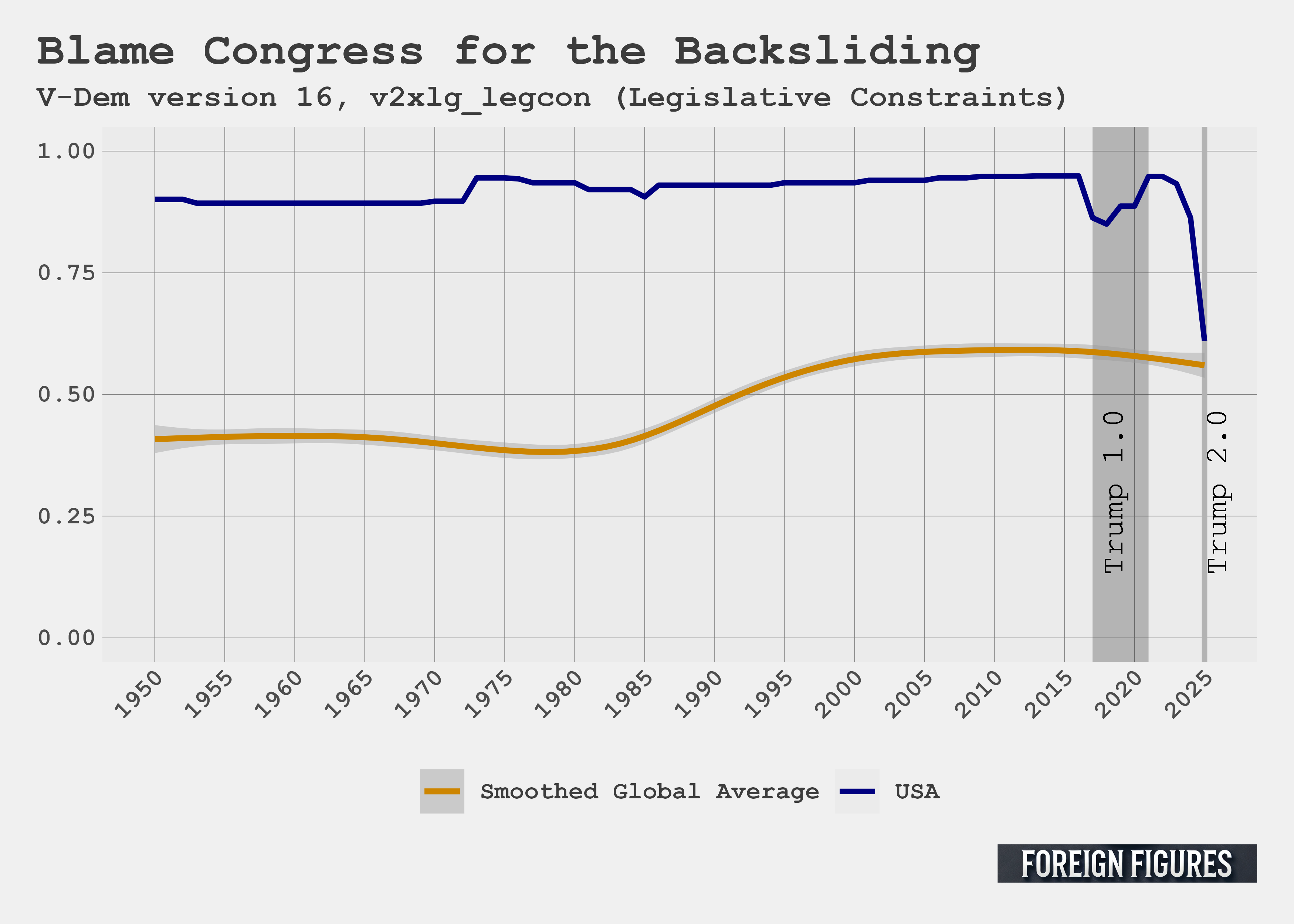
Since everyone loves to complain about Congress, I decided to start digging here, and sure enough, this dimension of democracy shows a major cratering, particularly in 2025. You can see this in the figure below. The blue line is America’s legislative constraints cores from 0-1, and the orange line is the smoothed over world average. From 1950 to 2024, America’s score stayed steady well above the global average. It took a hit during Trump’s first term in office, but only slightly. 2025 is the major break-point. As of last year, the quality of legislative constraints is only just a hair above the world average, which isn’t a great place to be. I should note that the most recent erosion started taking place during the Biden Administration after a brief rebound when Trump 1.0 left office. A lot of folks like to blame Trump 2.0 for the current collapse (which I think is a fair and evidence-based assessment), but the downward trend started in the last two years of the Biden Administration.
The measure of legislative constraints has subcomponents, too. V-Dem asked experts four questions that went into the construction of the legislative constraints measure. These questions had to do with how certain experts were about the presence of effective opposition parties in the legislature, whether legislatures investigate the executive for wrongdoing or illicit behavior, whether legislatures regularly call in executive branch officials for questioning, and whether legislatures exercise executive oversight. Not all of these questions have the same set of possible responses, but the answers can more or less be placed on a scale from “Unlikely” to “Likely” with “Uncertainty” placed in the middle. This is how I standardized the average responses to these questions before plotting them in the figure below.
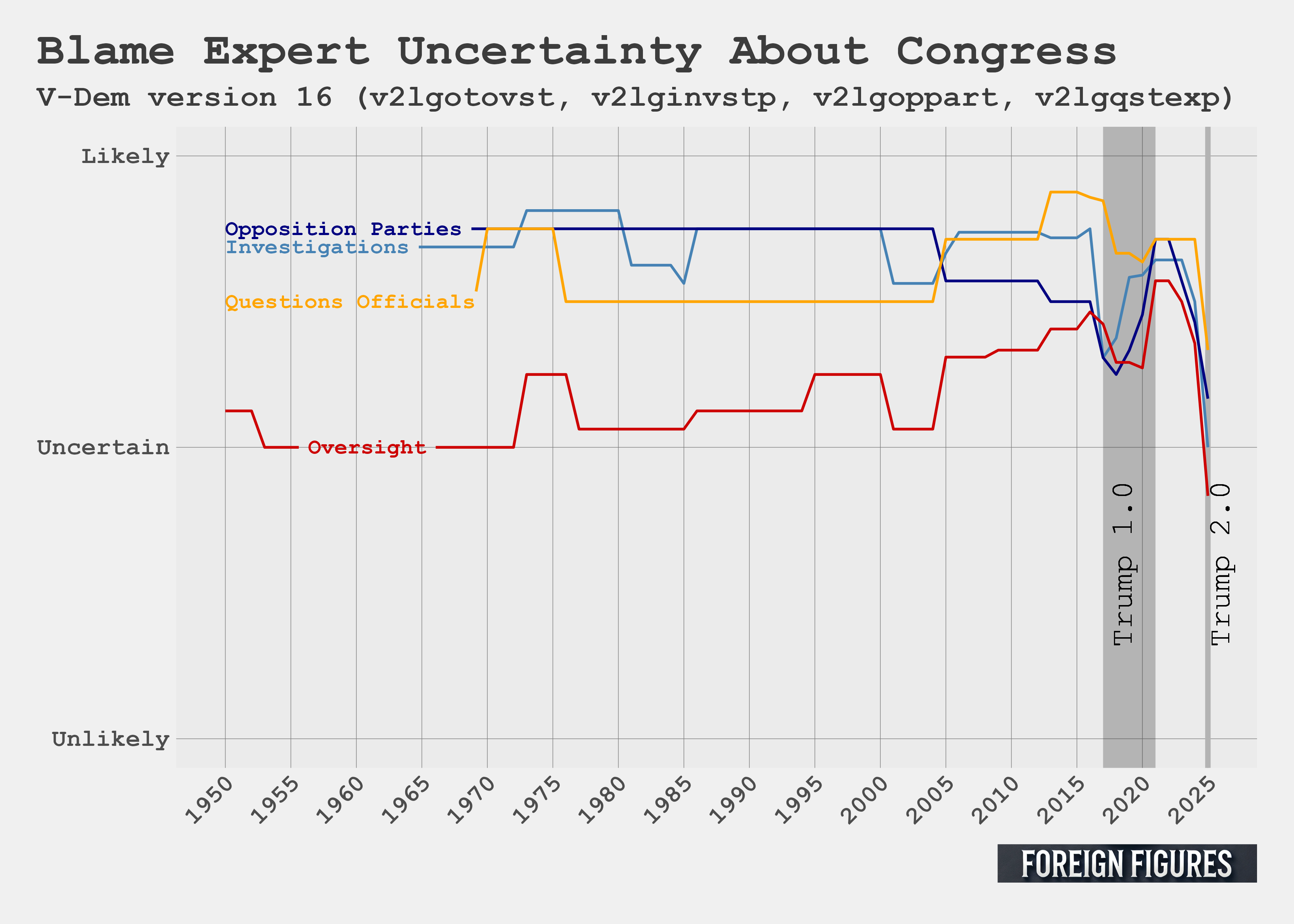
The defining expert opinion of US legislative constraints at the moment is “uncertainty.” Experts aren’t saying that Congress is certainly unlikely or unable to hold the executive branch accountable. They’re saying they just don’t know. This lack of certainty in Congress drives down America’s legislative constraints score, which in turn drags down America’s overall democracy score.
The takeaway
One thing is clear: experts have lost faith in Congress. Note that this collapse in faith is independent of changes to laws or the US Constitution. It’s the result of the behavior of Congress itself.
So, whether you agree with the experts that American democracy is backsliding, or you dislike the numbers and think they’re biased, one unifying force remains: you can blame Congress. Is there anything more American than that?
Code for this post can be found here.
Thanks for reading! You can support Foreign Figures by liking, sharing, buying me a coffee, or becoming a free or paid subscriber.