
Withdrawing from the World
A look at 50 years of public opinion on US foreign policy

Thanks for reading or listening! You can support Foreign Figures by liking, sharing, buying me a coffee, or becoming a free or paid subscriber.
This week’s Foreign Figures is NOT about the recent escalation in the Middle East. The reasons are threefold. First, I already had some content ready to go for this week, and I didn’t have time to generate new content. Second, I don’t feel comfortable chasing headlines. Third, I don’t think I have any insights to offer that haven’t already been offered by others.
What I will do is point you toward some previous posts of mine looking at two different sets of factors that I think do a reasonable job explaining patterns in conflict initiation, both of which provide, if not helpful, at least interesting frameworks for understanding US aggression toward Iran. The first centers on systemic dissatisfaction with the structure of the international system. The second centers on the absence of constraints on leaders willing to use military force. Both are in the archives, but I’ve unpaywalled them in case anyone wants to check them out.
Now, on with the show…
Sometimes the process of churning out material for Foreign Figures is messy. I usually have a bunch of ideas floating around in my head, and in a given week I pick one and see where it leads me. Sometimes where I end up is far, far away from where I started. This week is one of those weeks. Consider yourself warned.
The Chicago Council on Global Affairs has been fielding a survey of American public opinion on a core set of foreign policy issues for over 50 years, and one of these questions has to do with foreign aid (something I consider well within my wheelhouse). So I pulled their data and took a look at trends in support for US foreign aid over time. You can see the plot I made below.
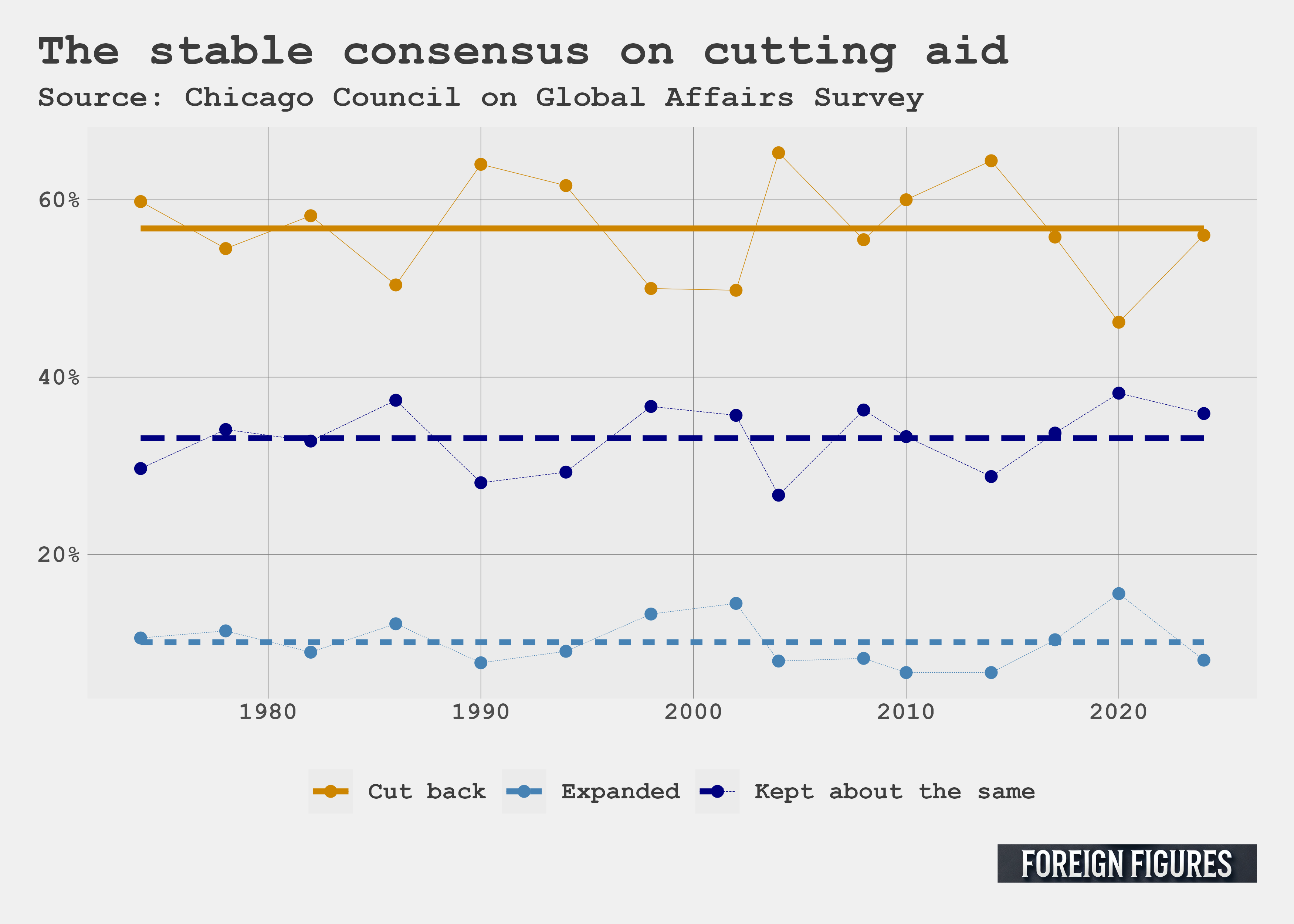
It shows the proportion of respondents over time, from 1974 to 2024 (the last year this particular question was asked), who indicated that the US should cut back, expand, or keep about the same US spending on economic aid to other countries. The results surprised me, but in retrospect they make a lot of sense. I expected to see a gradual erosion in support for expanding aid spending or keeping it about the same over time (an expectation that was probably driven by recency bias on my part). What the data shows instead is flat lines across the board. While there’s some variation from one survey wave to the next, there’s no detectable trend up or down in any of the response options. People today feel about the same about foreign aid as they did 50 years ago.
And their feeling is overall negative. The vast majority (nearly 60%) consistently say the US should cut back spending on economic aid to other countries. The remainder say spending should be expanded or kept the same, but those in the expanded bucket are relatively rare.
This finding is interesting in its own right, but here’s where a new thought hit me. Seeing these results made me wonder about inattention to foreign policy issues more broadly and how this might lead to a lot of stability in attitudes about foreign policy issues. I’ve discussed before how most Americans, in lots of different surveys, express negative attitudes toward foreign aid. Majorities, across the board, support cuts. That is, until they are told how much of the federal budget is actually spent on foreign aid. Once aid spending is put in context, people shift their views by tens of percentage points in the other direction. This can only mean one thing: people just aren’t paying attention to foreign aid. They answer this question on the basis of a vague sense that the US government should support domestic priorities over support for other countries; not on the basis of a rigorous budgetary calculation. They answer out of ignorance and vibes; not awareness and facts.
So, my hypothesis was, maybe this extends to other foreign policy issues in the survey: inattention promotes stability. So I decided to take a look at eight different questions in the survey asked over the past 50 years to see if there are positive or negative trends. I plotted the results in the figure below. Not every question was asked in the same survey year, but they are asked often enough to make out trends, if any are actually present.
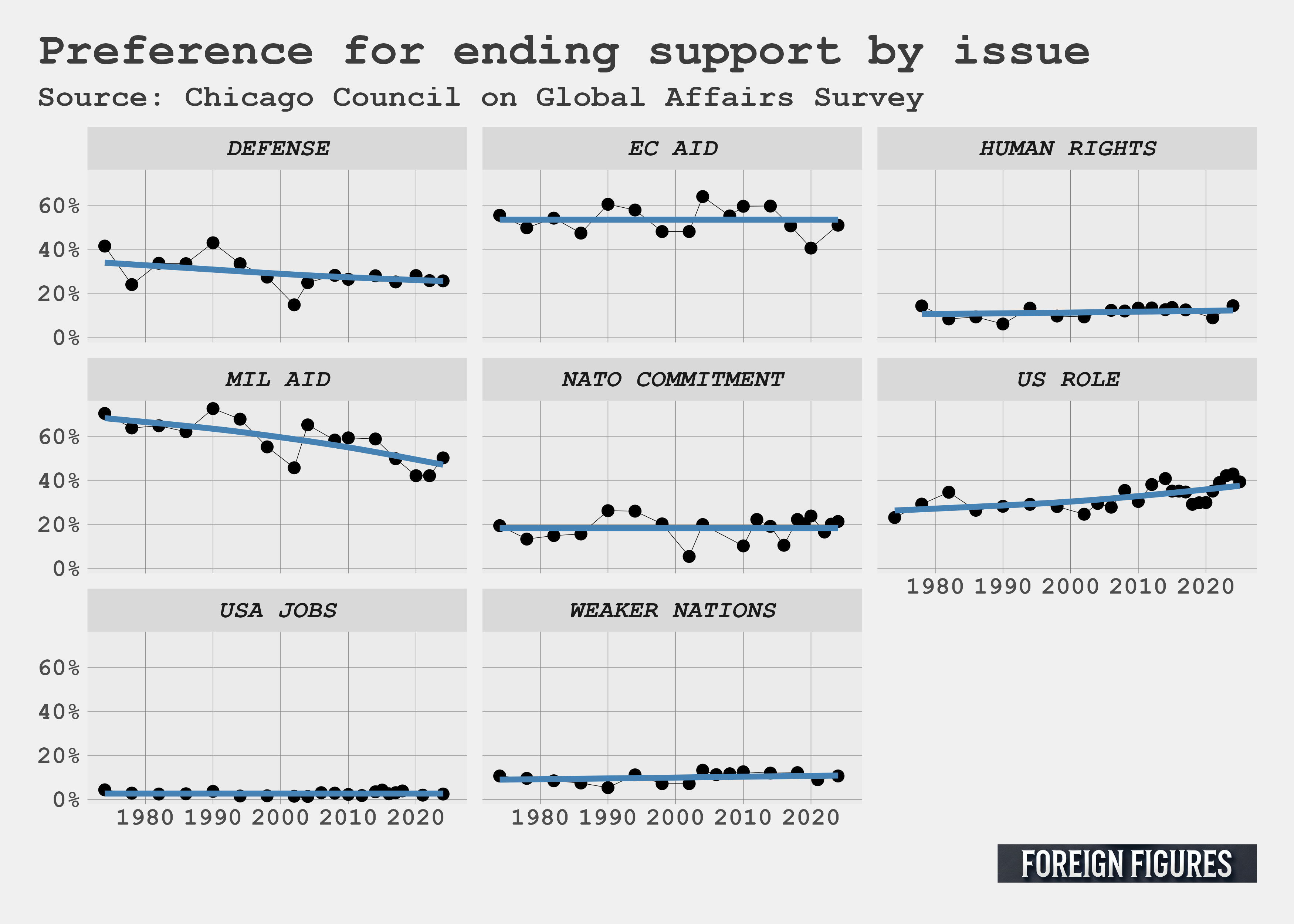
To keep things simple, I turned attitudes toward each issue into a simple binary, and calculated the percentage of people taking the view that support for an issue or policy should be decreased or ended. Policies include the defense budget, economic aid, military aid, promoting human rights abroad, commitment to NATO, whether the US should play a role in foreign policy, whether US foreign policy should promote US jobs, and whether the US should help weaker nations. As you can see, across most issues there’s stability, but there are a few exceptions. The share favoring cuts to the defense budget has been steadily declining from 40% in the 1970s to nearly 20% today. An even bigger decline can be seen in attitudes about cutting military aid to other countries. At the same time, there’s an upward trend in opposition to the US playing a major role in foreign policy.
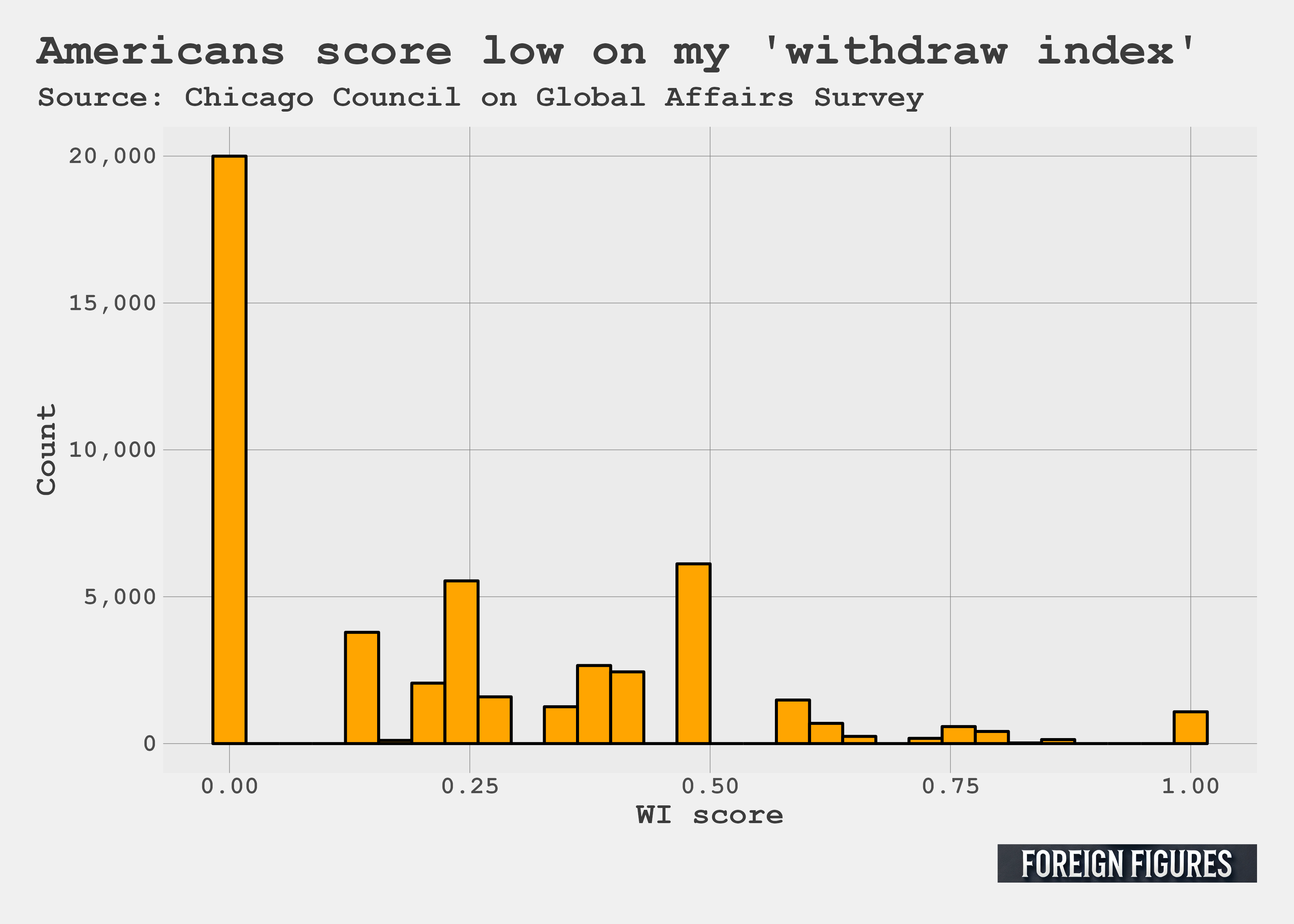
Here’s where another idea popped into my head. I bet I could take these binary versions of these measures and turn them into a single index of support for withdrawing the US from involvement in international politics. So, that’s just what I did. I made a 0-1 scale that called the “withdraw index” or WI. A higher score means a person is more opposed to the US playing much of a role in global affairs, and a lower score means a person is more supportive of a role for the US in global affairs.
You can see the distribution of WI scores I get in the histogram below. By and large, most Americans score low, which means they aren’t strongly opposed to an active US foreign policy. In fact, the modal score is 0. however, there’s still plenty of variation.
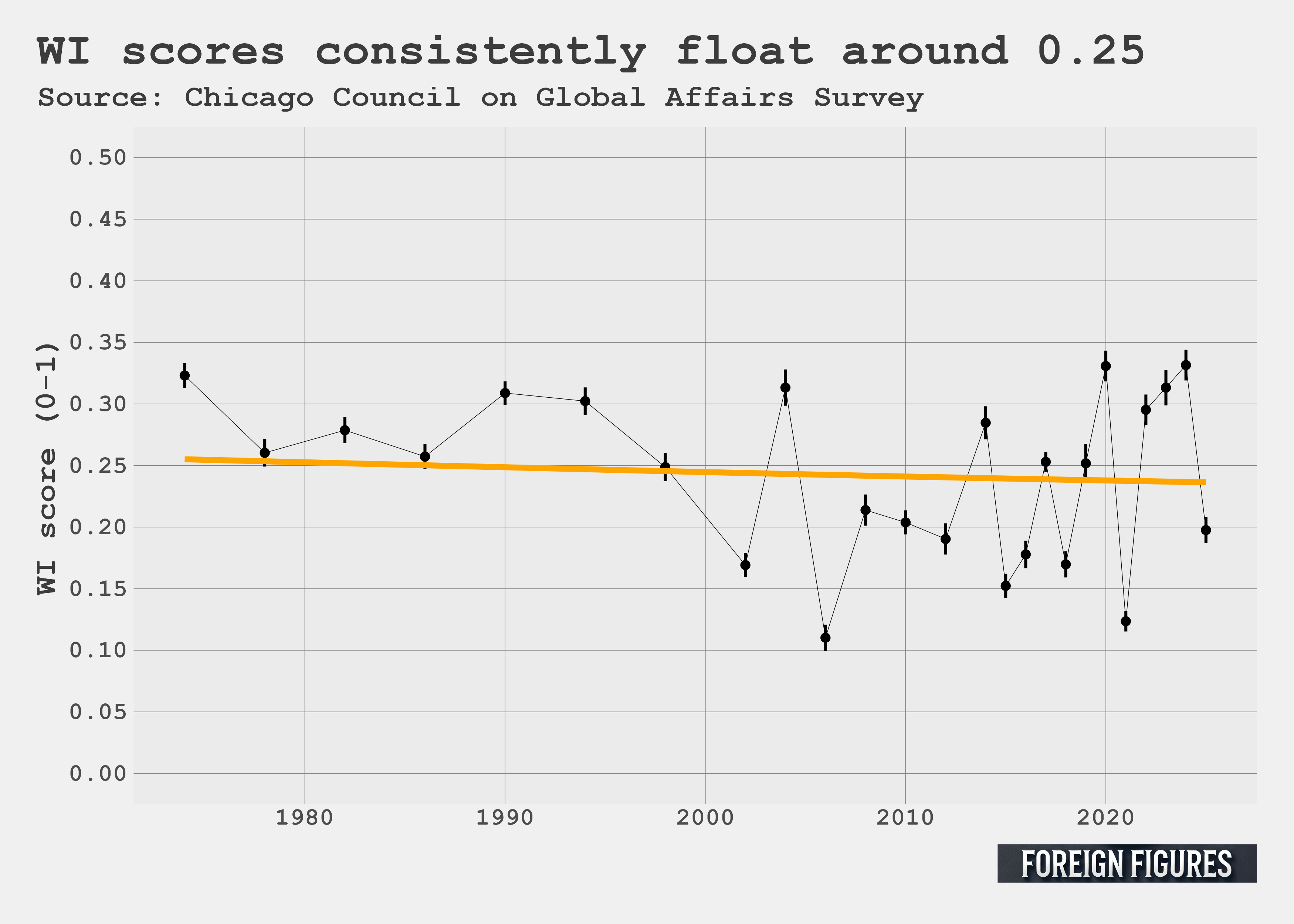
The next thing I got curious about was the trend in this WI score over time, so I made the next figure below. Two findings immediately stuck out. The first is that on average WI scores float around 0.25 over time. If you want to treat this score like a percentage, that means the American public is about 25% in favor of cutting back from active involvement in foreign policy. The second finding is that the trend over time is pretty stable, with an ever so modest but statistically detectible decline.
That’s kind of interesting, but the rabbit hole goes deeper. There might not be a lot of consistent shifts in attitudes over time, but I wonder if certain demographic factors incline people toward a higher WI score. This seems quite relevant, because if most people have a pretty uninformed view of foreign policy, they might turn to different heuristics to fill in the gaps in their understanding. Different backgrounds probably generate different heuristics. Thankfully, the Chicago Council data has a bunch of variables that I can use to test this idea.
I started by just looking at results from the most recent wave of the survey. I estimated a multiple regression model predicting WI scores in 2025 that included respondent age (their generation or birth cohort), whether they’re white, whether they have at least a bachelor’s degree, their party affiliation, and gender. The results are shown below in a coefficient plot. Here’s where all the lights start going off in my head.
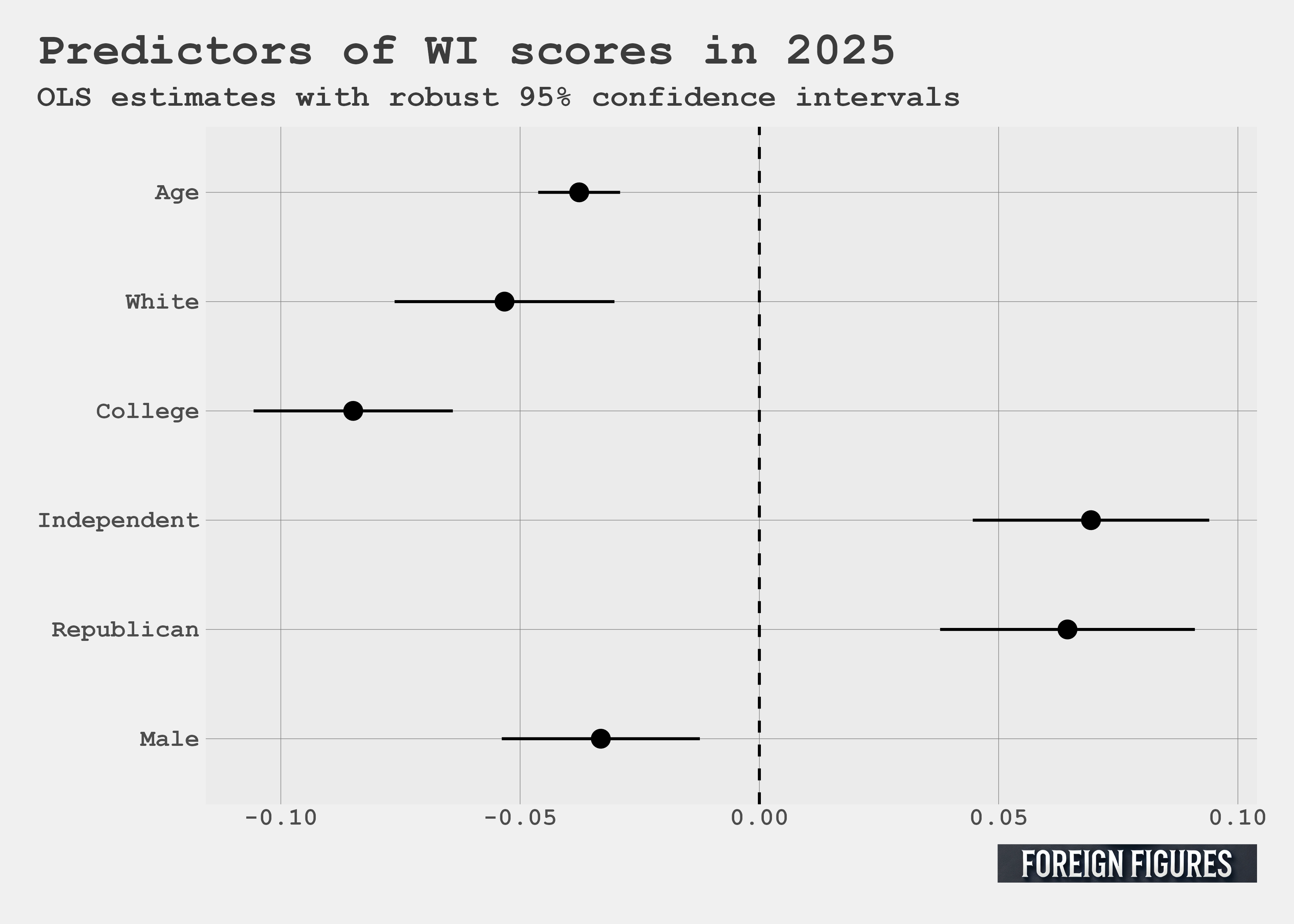
Each dot shows the expected change in WI score in 2025 per a change in each model predictor, controlling for all the other factors in the model. Every variable predicts a statistically significant change in WI scores. I’ll go from top to bottom.
First, age, which is just a numerical scale representing respondent generation starting with Gen Z and going back as far (theoretically) to the Silent Generation, predicts a decline in WI scores. Specifically, being one generation older predicts a less than 0.05 unit decline in WI. In practical terms, that means Gen Z is the most skeptical of a more involved US foreign policy, while older generations are less skeptical.
Second, white respondents on average are less skeptical of US foreign policy than non-white respondents. On average, being white predicts about a 0.05 decline in WI scores.
Third, a college education also predicts a decline in WI scores. This factor predicts the biggest change out of all the other factors in the model. Having at least a college degree predicts a nearly 0.1 unit decline in WI.
Fourth is party ID. The model has indicators for Independents and Republicans, meaning Democrats are the reference category or the baseline for these measures. Their estimates, therefore, indicate how different WI scores are for these groups relative to Democrats. Independents and Republicans each are predicted to be more skeptical of an active foreign policy than Democrats. Their estimates are roughly the same: about a 0.07 increase in WI scores.
Finally, male respondents were less skeptical of an active foreign policy than female respondents. In 2025, men were predicted to have a WI score 0.03 points lower than women.
If you put all these factors together, they can add up to really big differences for certain demographics. The most foreign policy skeptical group of people in 2025 tend to be younger, non-white, non-college educated women who identify as Independents or Republicans. Conversely, the group most supportive of an active foreign policy tend to be older, white, college educated men aligned with the Democratic Party.
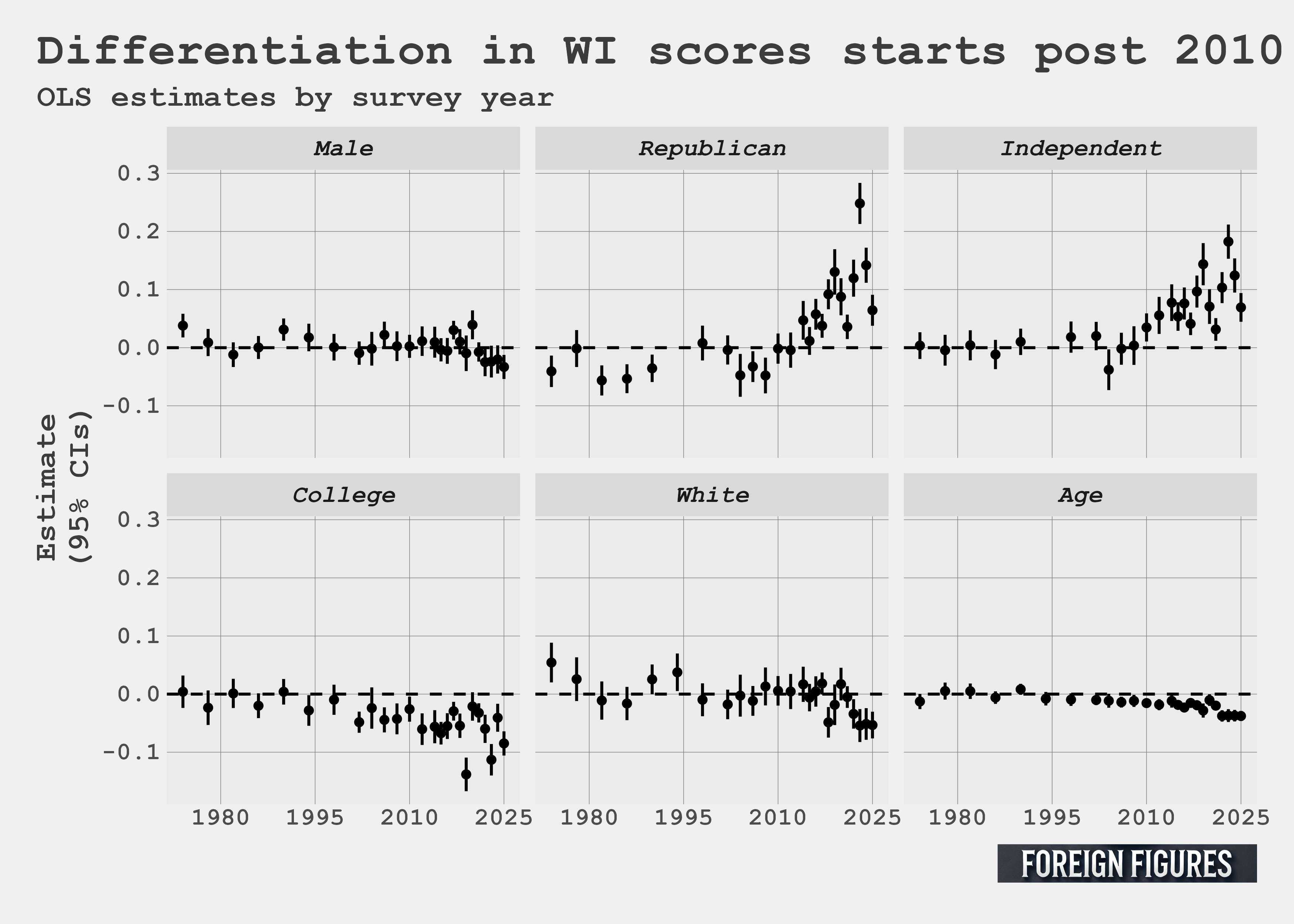
Now I have another question: was this always the case? To answer this question I decided to repeat this analysis in every survey wave in the data and put all the results in single plot, which you can see below. The answer is a definitive no. Many factors don’t start predicting systematically and substantially different WI scores until after 2010. Prior to 2010, age, race, gender, education, and party tended not to have a major differentiating effect on attitudes about US foreign policy. The factors that show the biggest shift in relevance are education and partisanship. Post-2010 being a college educated Democrat starts to serve as a much stronger predictor of support for a more active US foreign policy. I have a guess about why, and I suspect you do, too, but I’ll wait to talk about that until my conclusion.
Seeing how different the results are over time also made me wonder how different they might be for different subgroups, so I tried out a few different interactions between factors in the model to see if anything made a difference. I found two worth noting.
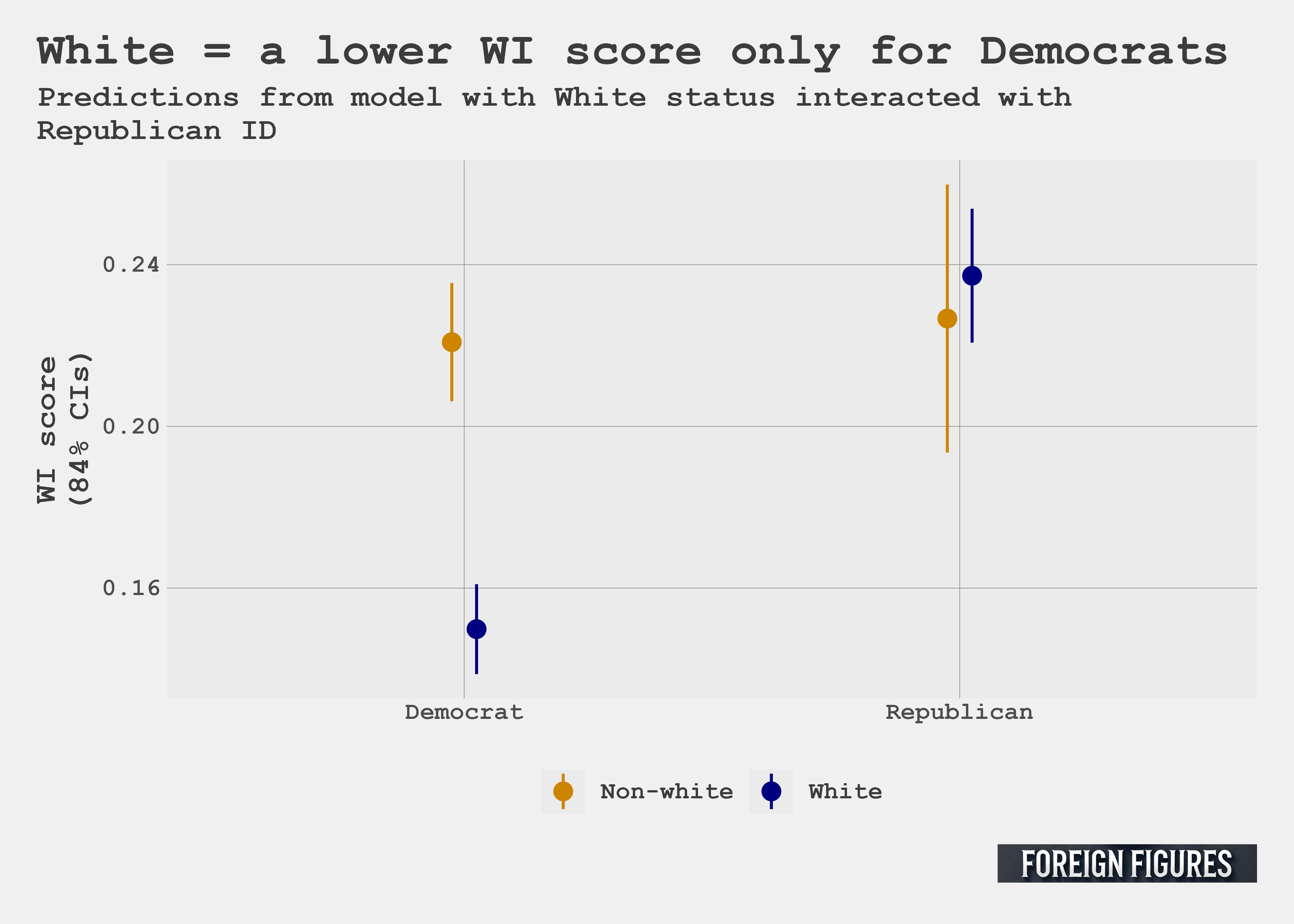
The first is the interaction between race and party. The results are in the plot below, which shows predicted WI scores in 2025 based on Republican ID and identifying as white. The interaction between these factors is substantial. For non-white respondents, going from being a Democrat to a Republican predicts basically no change in WI scores. But among white respondents, going from Democrat to Republican predicts a large positive change in WI scores, from about 0.15 to nearly 0.24. Essentially, non-white respondents, regardless of party ID, are statistically indistinguishable from white Republicans on foreign policy attitudes. The only group that stands out is white Democrats.
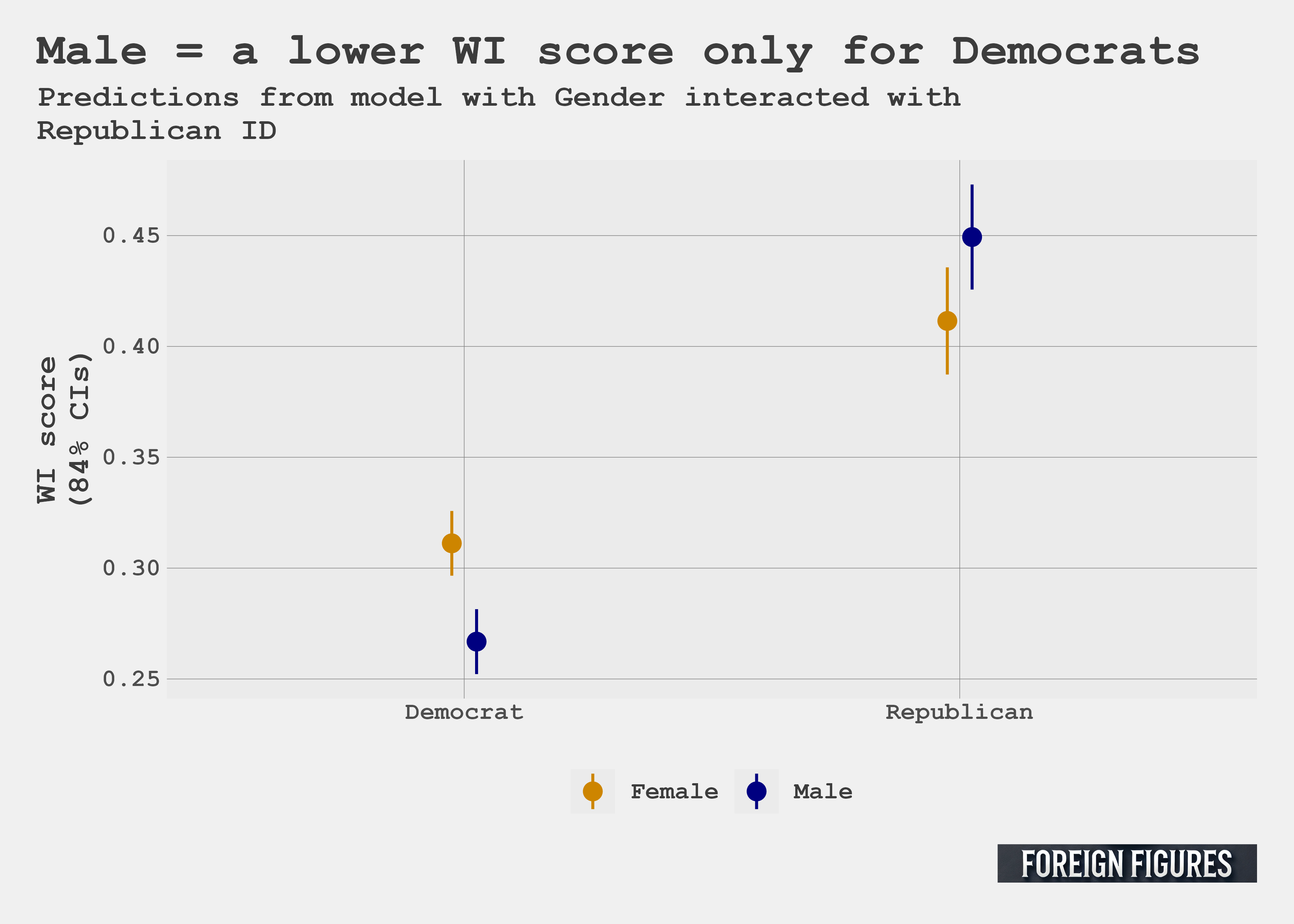
Gender also generated a significant interaction, but the result is less dramatic. You can see the results below. Only among Democrats does gender predict a significant difference in WI scores: women are just a few points higher than men on the WI scale. Among Republicans the direction of the relationship flips (men are more skeptical of an active foreign policy than women), but the difference isn’t statistically significant. However, the difference between parties is much bigger than differences due to gender. Female Democrats are still far less skeptical of an active foreign policy than Republicans, regardless of gender.
Let me try to thread the needle
Alright, let me try to make sense of this meandering analysis.
There is really one big takeaway for me: a person’s background plays a major role in shaping foreign policy attitudes. This probably isn’t that surprising, but what is surprising (again, probably due to my recency bias) is that background factors don’t really become relevant predictors until after 2010. Something in the water changed, and people started dividing on their level of skepticism toward an active US foreign policy along racial, generational, educational, partisan, and gendered lines.
I think the reason why is pretty clear: Trump’s first presidency. I don’t think Trump changed people’s factual understanding of foreign policy, but I do think his first term in office acted as a shock to the heuristics that different groups use to navigate abstract issues like foreign policy that most people have little direct experience with or knowledge about.
I’m curious to know how Trump’s second term in office will shock the system yet again. The irony is that Republicans are less inclined to support a more active US foreign policy than Democrats. Will that change as the Trump Administration amps up the interventionism? Probably. I’ve already seen polling moving in that direction. The heuristics of the present and the future are assuredly different from those of the past.
Code for this analysis can be found here.
Thanks for reading or listening! You can support Foreign Figures by liking, sharing, buying me a coffee, or becoming a free or paid subscriber.